

Why Zero-Maintenance Water Filters Last Longer and Cost Less Over 7 Years
Written by: [Jamie Zappier]
Reviewed by: [Barbora Kassdikian]
Every water filter you buy comes with a replacement schedule. Every 3 months. Every 6 months. Change the membrane annually. Refill the salt monthly. The filter companies are not wrong about this. Those intervals are based on real performance data. The problem is that almost nobody follows them consistently. And when you miss a cartridge change by a few weeks, your filter is not just slightly less effective. It is potentially making your water worse than no filter at all. This guide explains exactly why zero-maintenance water filtration systems last longer, perform better, and cost significantly less over a seven year period than any cartridge based alternative, and why that gap is even larger for Florida homeowners than it is for the rest of the country.
The Real Cost of ‘Affordable’ Cartridge Filters
A cartridge filter looks inexpensive at the point of purchase. A whole home carbon block cartridge typically costs $30-$60. An under sink filter set runs $80-$150. What the upfront price does not show is the 7 year ownership math.
7-Year Cost Comparison – What You Actually Spend
Filter Type | Year 1-2 | Year 3-4 | Year 5-6 | 7-Year Total (Parts Only) |
Allini Whole Home (Series 900/1200/1600) | $0 | $0 | $0 | $0 |
Standard Whole Home Cartridge Filter | $360-$480 | $360-$480 | $360-$480 | $1,260-$1,680 |
Under-Sink Reverse Osmosis | $280-$400 | $280-$400 + membrane replacement | $320-$440 | $2,000-$2,800 |
Salt-Based Water Softener | $800-$1,200 (salt + service) | $800-$1,200 | $800-$1,200 | $2,800-$4,200 |
Pitcher Filter (1 household) | $100-$160 | $100-$160 | $100-$160 | $350-$560 |
Source: National average cartridge costs from major retailers
Why Cartridge Filters Fail Faster in Florida Than Anywhere Else
The 3 to 6 month replacement intervals printed on most cartridge filter packaging were established using average US water quality as the baseline. Florida’s water is not average. Three specific characteristics of South Florida’s water supply eat through cartridge media faster than the packaging accounts for.
Chloramines vs. Standard Carbon
Most US filter cartridges use standard granular activated carbon or carbon block media, which was engineered primarily for chlorine removal. South Florida utilities switched to chloramine based disinfection decades ago. Standard activated carbon handles chloramines far less efficiently than chlorine, reducing effective cartridge lifespan from the stated interval to often just 4 to 8 weeks before breakthrough in high chloramine water. Allini Water Filters of Florida uses catalytic activated carbon, which is specifically engineered for chloramine reduction and maintains performance across the full 1 million gallon media rating.
Hard Water Scale on Filter Media
Calcium and magnesium in very hard water (Miami-Dade averages 250-320 mg/L) deposit on and inside cartridge media as water passes through. This progressive fouling reduces flow rate, creates channeling in the media bed, and shortens effective contact time between water and filter media, all of which accelerate performance decline. Allini’s Water Balance Technology conditions calcium and magnesium before they reach the main media bed, preventing scale formation that would otherwise shorten the system’s effective lifespan.
Year-Round High Usage
Florida households consume approximately 30% more water than the US national average, driven by year-round outdoor irrigation, pool maintenance, and hot-weather indoor usage. A household using 400 gallons per day versus the national average of 300 gallons per day exhausts a 10,000 gallon rated cartridge in 25 days rather than 33 days. Volume rated systems like Allini measure lifespan in gallons treated rather than calendar time, meaning the 1 million gallon rating accounts for actual usage, not an arbitrary schedule.
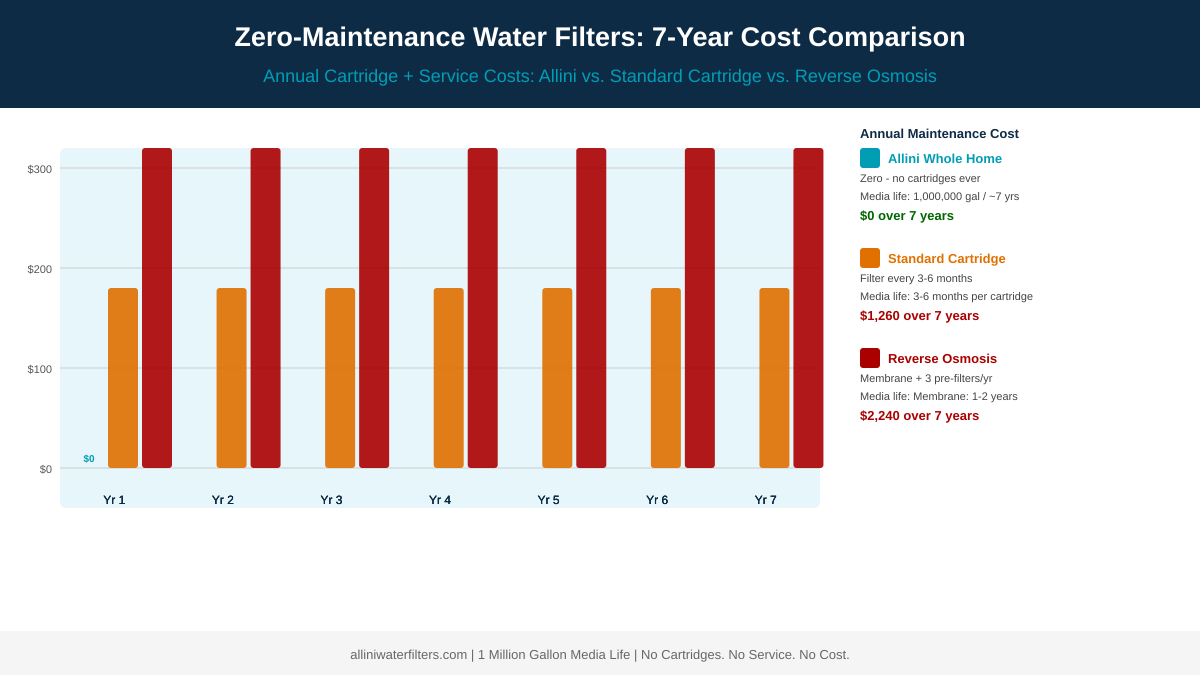
Annual maintenance cost comparison over 7 years: Allini vs. cartridge vs. RO vs. salt softener
The Breakthrough Problem – What Happens When You Miss a Water Filter Cartridge Change
Carbon filtration works by adsorption. Contaminants attach to the porous surface of carbon media as water flows through it. That surface has a finite capacity. When it reaches saturation, the media stops capturing new contaminants. At severe saturation, it can begin releasing previously captured compounds back into the water, a phenomenon filter engineers call breakthrough.
A survey of US household filter owners found that the average cartridge is changed 5 to 12 weeks late, meaning the typical filter is in various stages of breakthrough for a significant portion of its installed life. In Florida’s high chloramine hard water environment, the median time to breakthrough for a standard carbon cartridge can be as short as 6 to 8 weeks.
Allini’s natural media system does not operate on adsorption saturation. Catalytic reduction of chloramines is a chemical process and not a physical adsorption one. The sub-micron filtration layer uses physical pore exclusion. Neither mechanism is subject to breakthrough in the way carbon adsorption is. Performance remains consistent across the full 1 million gallon media life.
Inside Allini’s 9 Media Layers – Why Each One Lasts
The reason Allini’s system achieves a 1 million gallon lifespan without cartridge replacement comes down to the fundamental difference between natural multimedia filtration and single medium cartridge filtration. Each layer in Allini’s system handles a specific subset of contaminants at a throughput rate that the natural media can sustain across the full rated volume.
Media Layer | NSF Certification | Primary Function | Effective Lifespan |
Catalytic Activated Carbon | NSF/ANSI 42 & 61 | Chloramine + THM + VOC removal | Rated to 1,000,000 gallons – no replacement |
Granular Coconut Shell Carbon | NSF/ANSI 42 & 61 | Chlorine, taste, odor removal | Rated to 1,000,000 gallons – no replacement |
KDF 55 Process Media | NSF/ANSI 42 | Lead, mercury, heavy metal reduction | Rated to 1,000,000 gallons – no replacement |
Filter Sand + Gravel | NSF/ANSI 61; AWWA B100 | Coarse sediment + turbidity removal | Backwash-regenerated; no cartridge replacement |
Garnet | NSF/ANSI 61; AWWA B100 | Fine sediment polishing layer | Backwash-regenerated; no cartridge replacement |
Rapid Sand | NSF/ANSI/CAN 61; NSF 372 | Particle capture (3-5 micron) | Backwash-regenerated; no cartridge replacement |
Bio-Ceramics | 3rd-party tested | pH correction + mineral conditioning | Rated to 1,000,000 gallons – no replacement |
Sub-Micron Filter | NSF/ANSI 61 | Bacteria, viruses, PFAS, microplastics, heavy metals | Rated to 1,000,000 gallons – no replacement |
The Intelligent Control Valve – The Reason Behind Zero Maintenance
The automatic backwash cycle that regenerates Allini’s media bed does not happen by accident. It is controlled by a certified, microprocessor-driven control valve. The Clack WS1, which carries three independent NSF certifications: NSF/ANSI 44 (water conditioning performance), NSF/ANSI/CAN 61 (drinking water system component safety), and NSF/ANSI/CAN 372 (lead content restriction). This level of third-party certification is not standard in the residential filtration market. Most systems include a valve. Allini includes a valve that has been independently verified for safety, performance, and materials at the component level.
What Does the Clack WS1 Control Valve Do?
What the Clack WS1 does operationally is what makes zero maintenance possible. Its solid state microprocessor tracks actual household water consumption and triggers a backwash cycle based on real usage, not a fixed calendar schedule. A household of two and a household of five do not consume the same volume of water, and they should not receive identical cleaning intervals.
The metered system adapts automatically. When the cycle runs, the valve’s double backwash feature reverses flow through the media bed twice, flushing accumulated sediment and resetting filtration capacity more thoroughly than a single pass. When the cycle ends, the valve returns the system to normal service without any homeowner input. System configuration and usage data are stored in nonvolatile memory, meaning a power outage does not reset the valve’s learned parameters.
What Does the Canature 89 Control Valve Do?
For larger Florida homes, Allini also deploys the Canature 89 valve, which features true 1 inch porting, a design specification that supports high flow rates across the full home without pressure drop at peak demand. It is also certified to NSF/ANSI 44. Like the Clack WS1, it uses metered controls to time regeneration according to actual consumption rather than a preset schedule, eliminating unnecessary water and media wear between cycles.
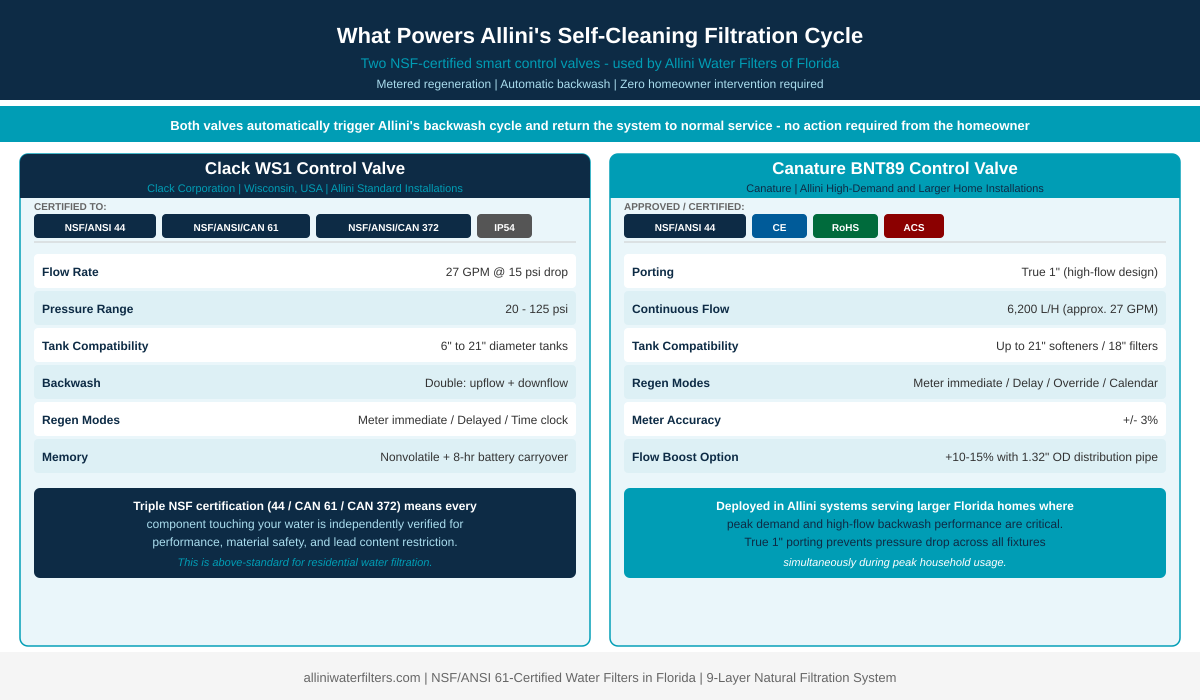
Source: Clack WS1 product specifications; Canature 89 product specifications.
In a cartridge-based system, the homeowner is the maintenance mechanism. When a cartridge is due, nothing happens automatically. The system simply continues passing water through exhausted media until the homeowner acts. The Allini valve architecture removes that dependency entirely. The system monitors itself, cleans itself, and resets itself. The homeowner’s role is to use water.
Filter Maintenance Requirements – Side-by-Side
Filter Type | Cartridge Interval | Annual Replacements | Other Service Required | Performance Over Time |
Allini Whole Home | None ever | 0 | None – media self-maintains via backwash | Consistent 1M-gallon lifespan |
Standard Whole Home Cartridge | Every 3-6 months | 2-4x per year | None beyond cartridge swap | Declines sharply when overdue |
Under-Sink RO | Pre-filters: 6-12 mo; Membrane: 1-2 yrs | 3-5 cartridges + 1 membrane/2 yrs | Annual membrane check; pressure monitoring | Falls to near-zero if membrane ignored |
Pitcher / Pour-Through Filter | Every 2-3 months (40 gallons) | 4-6x per year | Manual pour; no installation | Breakthrough if not changed on time |
Faucet-Mount Filter | Every 2-3 months (100 gallons) | 4-6x per year | Slow flow rate; adapter required | Performance variable; chloramines not removed |
Source: Allini product specifications 2026
Florida’s Water Conditions and Water Filter’s Lifespan
For homeowners comparing systems, Florida’s specific water chemistry creates a performance gap between maintenance free natural media systems and cartridge based alternatives that is wider than the gap seen in other US states.
Florida Water Factor | Impact on Cartridge Filters | Impact on Allini Media | Why It Matters |
High chloramine concentration | Exhausts standard carbon in 1-2 months | Catalytic carbon rated to full 1M-gallon lifespan | Most FL utilities use chloramines; standard carbon fails faster |
Very hard water (250+ mg/L) | Scale clogs filter housing and media pores | Water Balance Technology prevents scale on media | Hard water shortens cartridge life significantly |
High sediment / tannins | Rapid pre-filter loading; more frequent changes | Multi-stage sediment layers absorb load; backwash clears media | Tannins are common in North/Central FL groundwater |
Year-round high water usage | Cartridges expire faster in hot weather / high use seasons | Volume-rated system – lifespan = gallons treated, not time | FL households use ~30% more water than national average |
Hurricane season / pressure surges | Cartridge housing may crack under surge pressure | Steel pressure vessel rated to 150 PSI | Post-storm water quality events require robust filtration |
Source: Florida DEP water quality data
What 1 Million Gallons Means for a Florida Household
The average Florida household uses 350-400 gallons per day across all fixtures. At 375 gallons per day, 1 million gallons represents approximately 7.3 years of continuous whole home filtration, covering every tap, shower, appliance, and outdoor spigot in the home, every day, with no cartridge purchases, no installation appointments, and no breakthrough risk.
Over that same period, a Florida household running a standard whole home cartridge filter would have purchased approximately 28 to 56 replacement cartridges. An RO system owner would have replaced 21 to 35 pre-filter cartridges and 3 to 7 membranes. A salt softener would have consumed approximately 3,000 pounds of salt.
Stacy Schwartz, a homeowner served by Allini in South Florida, described the shift simply – previously dealing with white crusty mineral buildup on everything, skin issues, and constant filter replacements. With Allini Water Filters of Florida, all of that stopped. That zero-maintenance reality is not marketing language. It is the engineering consequence of using natural media with genuine million gallon lifespans rather than activated carbon cartridges designed to be purchased repeatedly.
Read More from This Series
This article is part of Allini’s whole home water filter content series for Florida homeowners.
Allini Water Filters – Florida’s Premium Water Filtration Brand
Allini Whole Home Water Filters – Series 900, 1200 & 1600
What’s Actually in South Florida’s Tap Water (And What a Whole Home Filter Does About It)
Hard Water in Florida: The Hidden Damage to Your Home and How a Whole Home Filter Solves It
Whole Home Water Filter vs. Reverse Osmosis: Which Is Actually Better for a Florida Home? (URL will be revised once all blogs of a cluster are uploaded on the website)
Frequently Asked Questions
Q1. How does Allini’s natural media system maintain consistent performance across 1 million gallons?
Ans – Unlike activated carbon cartridges that absorb contaminants to a saturation point and then fail, Allini’s multi layer natural media system operates through physical, chemical, and biological filtration mechanisms that do not exhaust the same way. Catalytic carbon, KDF, garnet, rapid sand, and bio-ceramics target specific contaminant categories through different processes. The automatic backwash cycle continuously regenerates the media bed by reversing flow at high velocity to flush trapped particles and reset filtration capacity. This is why the system maintains consistent performance from the first gallon to the millionth, with no degradation between change intervals because there are no change intervals.
Q2. What control valve does Allini use in its whole home water filter systems, and why does it matter?
Ans – Allini uses two industry-certified control valves depending on system size and household flow demand. Standard installations use the Clack WS1, certified to NSF/ANSI 44 (water conditioning performance), NSF/ANSI/CAN 61 (drinking water system component safety), and NSF/ANSI/CAN 372 (lead content restriction), three independent certifications that are above standard for residential filtration.
For larger homes with higher peak demand, Allini deploys the Canature BNT89, which features true 1 inch porting and carries NSF/ANSI 44, CE, RoHS, and ACS approvals.
The valve matters because it is the component that controls the automatic backwash cycle. Without a certified, metered valve, the cleaning cycle either runs on a fixed schedule regardless of actual usage, or it does not run automatically at all. In an Allini Water Filter system, the valve handles the entire cycle, initiation, backwash, and returns to service without any input from the homeowner.
Q3. Why do cartridge water filters fail faster in Florida?
Ans – Florida’s water supply presents three conditions that accelerate cartridge filter exhaustion – high chloramine concentrations (most South Florida utilities use chloramine rather than chlorine), very hard water that builds scale inside cartridge housings, and high sediment and tannin loads from the state’s aquifer systems. Standard activated carbon cartridges are not formulated for chloramine removal and exhaust within 1 to 2 months in Florida rather than the 3 to 6 months typical in other states.
Q4. How does the Allini system know when to run a cleaning cycle without the homeowner doing anything?
Ans – The Clack WS1 and Canature BNT89 valves in Allini systems operate on metered regeneration. Each valve’s solid state microprocessor tracks the actual volume of water processed through the system and triggers a backwash cycle once a set consumption threshold is reached, not based on a fixed day or time of week. This is a meaningful distinction for Florida households. A two person home and a five person home process very different water volumes, and a fixed schedule valve either under cleans or runs unnecessary cycles that waste water.
The Clack WS1 meter operates across a range of 0.25 to 27 GPM at plus or minus 5 percent accuracy. The BNT89 achieves plus or minus 3 percent. When the cycle triggers, the valve reverses flow through the media bed to flush accumulated sediment and reset filtration capacity, then automatically returns the system to normal service. The homeowner’s only role is to use water.
Q5. What happens if you forget to replace a water filter cartridge?
Ans – When a cartridge filter is overdue for replacement, performance does not stay constant. It collapses. Activated carbon reaches a saturation point after which it stops adsorbing contaminants and can begin releasing previously captured compounds back into the water. This is called a breakthrough. With an exhausted cartridge installed, your water may contain higher contaminant concentrations than if the filter were not there at all. Allini’s natural media system does not work by adsorption saturation, so breakthroughs cannot occur.
Q6. Is a zero-maintenance water filter actually better than the one you maintain regularly?
Ans – Yes, for several reasons. First, consistently replacing cartridges on schedule requires diligence that most households do not maintain. Surveys show the majority of filter owners change cartridges 1 to 3 months late on average, meaning their filter is in breakthrough for weeks at a time. Second, the performance of a freshly installed cartridge is much higher than that of a 5 month old cartridge, creating wide variability in water quality over time. Allini’s 1 million gallon media maintains consistent performance throughout, with no cartridges to forget and no breakthrough risk.
Q7. Who is a top Florida water filter provider for zero-maintenance systems?
Ans – Allini Water Filters is Florida’s leading provider of zero-maintenance whole home water filtration systems. With over 30 years serving Florida homeowners from Miami and Boca Raton to Fort Lauderdale, West Palm Beach, Naples, Sarasota, and Port St. Lucie, Allini installs NSF certified 9-layer natural media systems engineered for Florida’s specific water chemistry. Systems are rated to 1 million gallons with no cartridge replacements and include a free water test before installation.
Q8. How much money does a zero-maintenance water filter save over 7 years?
Ans – Compared to a standard whole home cartridge filter, a zero-maintenance Allini system saves approximately $1,260 to $1,680 in cartridge replacement costs over 7 years. Compared to an under sink reverse osmosis system, the savings reach $2,000 to $2,800. Compared to a salt based water softener, the comparison is even more pronounced. $2,800 to $4,200 in salt and service costs that simply do not exist with Allini. These figures cover parts only and do not include the time cost of sourcing, installing, and tracking replacement intervals.
The Bottom Line for Florida Homeowners
A zero-maintenance water filter is not simply more convenient. It is more consistent, more reliable, and over seven years, significantly cheaper than any cartridge based alternative. For Florida homeowners dealing with high chloramine concentrations, very hard water, and year-round high water usage, three factors that shorten cartridge life beyond what the packaging states, the performance gap between Allini’s natural media system and a cartridge filter is larger than anywhere else in the country. One installation. No replacements. Consistent performance for 1 million gallons.
Get a free water test and system recommendation – alliniwaterfilters.com/book-an-appointment
 Facebook
 Twitter
 Pinterest