

Hard Water in Florida - The Hidden Damage to Your Home and How a Whole Home Filter Solves It
Florida homeowners often notice the symptoms before they understand the cause liike white crust on showerheads, spots on dishes that won’t come off, appliances that fail years ahead of schedule, and water that leaves skin feeling dry no matter how long they shower. All of these are consequences of very hard water, and South Florida has some of the highest hardness levels in the country. This guide explains exactly what hard water does to your home, why salt based softeners are not the right answer for Florida, and how Allini’s Water Balance Technology solves the problem without salt, chemicals, or any ongoing maintenance.
South Florida’s Hard Water Problem by the Numbers
Water hardness is measured in milligrams per liter of calcium carbonate (mg/L CaCO3). Anything above 180 mg/L is classified as very hard by the US Geological Survey. The Biscayne Aquifer and Floridan Aquifer that supply most of South Florida’s water run through limestone formations, which dissolve calcium and magnesium into every gallon pumped to your tap.
Florida Water Hardness by County
County/Area | Hardness (mg/L CaCO3) | Classification | Typical Home Symptoms | Water Source |
Miami-Dade | 250-320 mg/L | Hard | Heavy scale, dry skin, spotting | Biscayne Aquifer |
Broward County | 180-250 mg/L | Moderate Hard | Appliance scale, dry hair | Surficial Aquifer |
Palm Beach County | 200-280 mg/L | Hard to Very Hard | Tile staining, heater scale | Well fields + Lake O. |
Collier / Naples | 240-300 mg/L | Hard to Very Hard | Severe scale, brackish taste | Tamiami Aquifer |
Sarasota | 300-400 mg/L | Very Hard | Spotting, mild scale | Peace River watershed |
Port St. Lucie | 160-220 mg/L | Moderate Hard | Appliance wear, soap scum | Surficial Aquifer |
Sources: USGS Water Quality Atlas, Florida DEP, county utility Consumer Confidence Reports 2024-2026.
What Hard Water Actually Does to Your Home
Scale buildup is not merely a cosmetic issue. Calcium and magnesium deposits that form on heating elements, inside pipes, and within appliances carry real financial and structural consequences that accumulate silently over months and years.
Appliance Efficiency and Lifespan
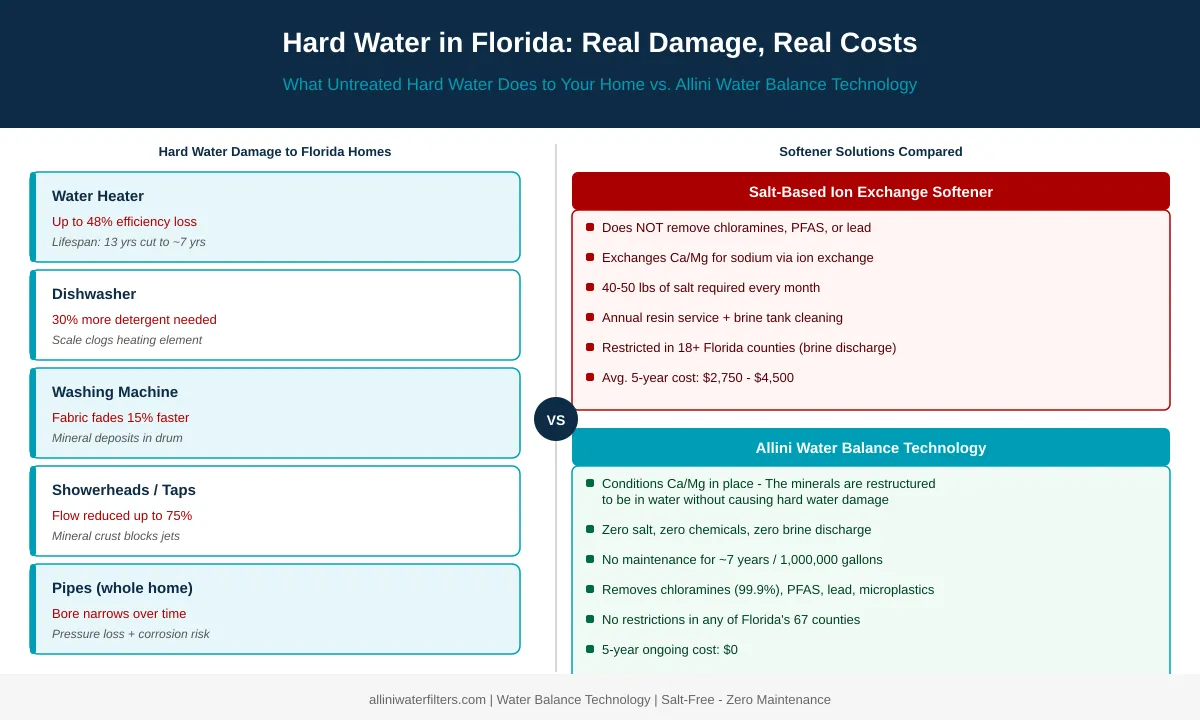
When scale forms on a water heater’s heating element, the element must work harder to transfer the same amount of heat. The US Department of Energy has documented efficiency losses of up to 48% in severely scaled water heaters, the equivalent of nearly half your water heating energy bill going to fight mineral buildup rather than actually heating water. The National Sanitation Foundation estimates that hard water reduces water heater lifespan from an average of 13 years to around 7 years. Dishwashers, washing machines, and coffee makers suffer similar scale accumulation on their internal heating components.
Plumbing and Pressure Loss
Inside copper and galvanized steel pipes, scale builds up on interior walls over time. In Florida homes built before 1990 with smaller diameter pipes, this progressive narrowing creates measurable pressure loss and increases the risk of localized pipe failure. Replacing plumbing in a Florida home typically costs $4,000-$15,000 depending on the extent of work required.
Skin, Hair, and Daily Living
Hard water reacts with soap and shampoo to form a mineral soap scum rather than lathering properly. This film deposits on skin and hair after rinsing, stripping natural oils and leaving a residue that contributes to dryness, irritation, and dull hair. In South Florida, this effect compounds with chloramine-treated water which also absorbs through skin and lungs during showers to create a double irritant load that standard filtered water does not carry.
Hard Water Damage by Appliance – Costs and Lifespan Impact
Appliance | Hardness Impact | Efficiency Loss | Lifespan Reduction | Est. Annual Cost Impact |
Water Heater | Scale on element | Up to 48% | 13 yrs to ~7 yrs | $200-$400 in energy waste |
Dishwasher | Scale on heating element | 30% more detergent | ~2-3 years shorter | $150-$250 extra per year |
Washing Machine | Mineral deposits in drum | Fabric fades 15% faster | ~2 years shorter | $100-$200 extra per year |
Showerheads / Faucets | Mineral crust on jets | Flow reduced up to 75% | Requires replacement 2x sooner | $80-$150 in replacements |
Water Pipes (whole home) | Scale narrows pipe bore | Pressure loss over time | Accelerated corrosion risk | $300-$1,000+ in repairs |
Source: US Department of Energy Water Heater Efficiency Study; NSF appliance lifespan data; Allini customer survey data, Florida 2024.
Why Salt-Based Softeners Are Not the Right Solution for Florida
The traditional response to hard water is a salt-based ion exchange softener. These systems pull calcium and magnesium out of the water and replace them with sodium ions, which do not form scale. The problem is that this approach creates a separate set of issues that are particularly acute for Florida homeowners.
Florida county restrictions
As of 2026, at least 18 Florida counties and municipalities have enacted restrictions or outright bans on salt-based water softeners. The brine discharge from softener regeneration cycles enters Florida’s freshwater and coastal ecosystems and contributes to salinity problems in an already stressed water system. Counties that have restricted softeners include communities in Sarasota, Charlotte, Lee, Collier, Palm Beach, and St. Johns Counties.
Sodium in your drinking water
Ion exchange softeners add sodium to every gallon they treat. For households with sodium restricted diets, heart conditions, or blood pressure concerns, this is a meaningful health consideration.
No contaminant filtration
A water softener addresses hardness only. It does not remove chloramines, trihalomethanes, PFAS, heavy metals, lead, arsenic, or microplastics. Florida homeowners who install a salt softener still have all of those contaminants in their water.
Ongoing cost and labor
Salt softeners require 40-50 pounds of salt per month, annual resin bed servicing, and brine tank cleaning. The 5 year ownership cost for a salt softener typically runs $2,750-$4,500 in operating expenses alone.
Allini’s Water Balance Technology – A Better Solution for Florida
Allini’s approach to hard water is fundamentally different. Water Balance Technology does not remove calcium and magnesium. It conditions them.
Through a specific sequence of bio-ceramic and natural media interactions, Water Balance Technology converts calcium and magnesium ions from their scale forming crystalline state to a non adhesive aragonite form. The minerals remain in the water and you still get the health benefits of calcium and magnesium in every glass but they pass through pipes, showerheads, appliances, and heating elements without bonding to surfaces or building scale.
The result – No white crust on showerheads. No scale on heating elements. No spots on dishes. No buildup in pipes. And no salt, no brine, no chemical discharge, and no restrictions in any of Florida’s 67 counties.
Salt Softener v/s Allini Water Balance Technology – Full Comparison
Feature | Salt-Based Ion Exchange Softener | Allini Water Balance Technology |
How it works | Exchanges Ca/Mg for sodium via resin beads | Conditions minerals so they cannot bond or form scale |
Salt required | Yes – 40-50 lbs per month per household | No – zero salt, zero chemicals, ever |
Beneficial minerals | Removed – calcium and magnesium stripped out | Retained – minerals stay in water in non-scale form |
Wastewater produced | Yes – brine discharge during regeneration cycle | None |
Contaminant removal | Hardness only – does not remove chloramines, PFAS, or heavy metals | Full spectrum – 15+ contaminant categories including chloramines, PFAS, heavy metals, microplastics |
Maintenance | Refill salt monthly; annual resin service; brine tank cleaning | Zero maintenance for ~7 years / 1 million gallons |
5 year cost | $400-$600/year in salt + $150-$300/year in service = $2,750-$4,500 over 5 years | One-time installation – $0 ongoing maintenance cost |
Environmental impact | Brine discharge harms soil and waterways; 18 FL counties restrict salt softeners | Zero waste water or chemical discharge |
Hard Water Solutions Compared – Which Is Right for Florida?
Florida homeowners evaluating hard water solutions often compare salt softeners, electronic descalers, citric acid systems, and whole home filters. Here is how they stack up against the specific challenges of South Florida’s water chemistry.
Criteria | Salt Softener | Electronic Descaler | Citric Acid Systems | Allini Whole Home System |
Hardness control | Removes minerals | Partial (debated) | Moderate | Yes – scale prevention |
Contaminant removal | No | No | No | Yes – full spectrum |
Chloramine removal | No | No | No | Yes – 99.9% |
Salt / chemicals | 50 lbs/month | None | Citric acid refills | None |
Media lifespan | Resin: 10-15 yrs (with service) | Device: 5-10 yrs | Refill every 1-3 months | 1 million gal / ~7 yrs |
FL county restrictions | 18 FL counties restrict or ban | None | None | None |
Source: Allini product testing data; NSF certification records; Florida DEP salt softener restriction data 2026.
What Allini Customers in South Florida Say
The water quality difference Allini customers in Miami, Boca Raton, Fort Lauderdale, West Palm Beach, Sarasota, and Naples report, is consistent. Scale buildup stops within weeks of installation, skin and hair feel different immediately after shower water is conditioned, and appliances run more quietly without the mineral chatter of scale coated heating elements.
Bruce Rubinowicz, a homeowner in Boynton Beach, reported after installation that the water tastes cleaner and the difference in his skin and hair quality was noticeable within days. That is the double benefit of Allini’s approach. Contaminant removal and hardness conditioning working simultaneously, from a single system with no ongoing cost.
Read More from This Series
This article is part of Allini’s whole home water filter content series for Florida homeowners.
Allini Water Filters – Florida’s Premium Water Filtration Brand
Allini Whole Home Water Filters – Series 900, 1200 & 1600
A Blog On – What’s Actually in South Florida’s Tap Water (And What a Whole Home Filter Does About It)
A Blog On – Why Zero-Maintenance Water Filters Last Longer and Cost Less Over 7 Years
A Blog On – Whole Home Water Filter vs. Reverse Osmosis: Which Is Actually Better for a Florida Home?
Frequently Asked Questions
Q1. Is hard water dangerous to drink in Florida?
Ans. Hard water is not a direct health risk when consumed. The calcium and magnesium that cause hardness are essential minerals. Hard water accelerates appliance failure, reduces filtration media efficiency, and creates favorable conditions for scale formation inside pipes and heating elements. For Florida homeowners, the financial and maintenance costs are the primary issue.
Q2. Does a salt-based water softener remove chloramines from South Florida water?
Ans. No. Salt-based ion exchange softeners address hardness minerals only. They do not remove chloramines, trihalomethanes, PFAS, heavy metals, or any other chemical contaminants. A water softener and a water filter are two different categories of equipment. Allini’s whole home system combines hardness conditioning and full spectrum filtration in a single unit with no salt and no ongoing maintenance.
Q3. What is Water Balance Technology and how is it different from a water softener?
Ans. Yes. As of 2026, at least 18 Florida counties and municipalities have enacted restrictions or outright bans on salt-based water softeners due to the impact of brine discharge on the state’s freshwater and coastal ecosystems. Allini’s Water Balance Technology conditions hardness without salt, producing zero brine discharge and carrying no restrictions anywhere in Florida.
Q4. What is Water Balance Technology and how is it different from a water softener?
Ans. Water Balance Technology is Allini’s proprietary approach to hardness conditioning. Rather than removing calcium and magnesium from the water through ion exchange, Water Balance Technology restructures those minerals so they remain suspended in the water in a non adhesive form. They pass through your pipes and appliances without bonding or forming scale. Beneficial minerals stay in your water. No salt. No brine. No stripped minerals.
Q5. How does hard water affect skin and hair in Florida?
Ans. Hard water interferes with soap lather and leaves a mineral film on skin and hair after washing. This mineral residue disrupts the skin’s natural moisture barrier, contributing to dryness, irritation, and eczema flare-ups. In South Florida, this effect is compounded by chloramine treated water, which also absorbs dermally through shower water. Allini’s whole home filtration addresses both – Water Balance Technology prevents mineral film formation, while catalytic carbon eliminates chloramines at the point of entry.
Q6. Which water filters are best for hard water problems in Florida?
Ans. For Florida homes with hard water, the most effective solution is a whole home filter with built-in hardness conditioning. Unlike standalone softeners that only address hardness, Allini Water Filters for Florida combines a 9 layer natural media system with Water Balance Technology to treat both contaminants and hardness in a single maintenance free unit. It requires no salt, produces no wastewater, and is approved for use in all 67 Florida counties.
The Bottom Line for Florida Homeowners
Hard water is not just a nuisance, it is a slow moving cost that compounds every month across every appliance, every pipe, and every shower in your home. For South Florida homeowners facing some of the highest hardness levels in the country, the right response is not a salt softener that trades one problem for three others.
Allini’s Water Balance Technology was specifically designed for Florida’s limestone filtered, chloramine treated water supply for conditioning hardness, removing contaminants, and doing both with zero maintenance for up to seven years.
 Facebook
 Twitter
 Pinterest