

What's Actually in South Florida's Tap Water and What a Whole Home Filter Does About It
Florida water utilities send out annual quality reports showing every result within legal limits and on paper. But those limits were established decades ago, before researchers fully understood the long term health effects of chloramines, disinfection byproducts, and PFAS at low concentrations. Miami-Dade, Broward, and Palm Beach County homeowners are drinking water that legally passes every test while still containing measurable levels of compounds now linked to cancer, endocrine disruption, and immune system damage. This blog cum guide breaks down exactly what is flowing through South Florida taps in 2026, what each contaminant does at chronic exposure levels, and how a whole home water filter system removes it before it reaches any faucet in your home.
What Florida Water Quality Reports Actually Tell You and What They Leave Out
Florida’s annual water quality (Consumer Confidence) reports confirm that utilities meet all current federal and state limits. What they do not highlight is that many of those limits were set before the full body of health research was complete.
A few examples worth understanding:
- Trihalomethanes (THMs) carry a national limit of 80 parts per billion (ppb). Studies published since that standard was set have linked chronic THM exposure at levels well below 80 ppb to increased bladder cancer risk in population studies spanning 20 plus years.
- PFAS compounds now have enforceable limits for six specific variants at 4 parts per trillion (EPA 2024). Florida utilities are working toward compliance, but PFAS from military bases, industrial discharge, and agricultural runoff have been detected in Florida groundwater for decades before regulation arrived.
- Microplastics have no federal maximum contaminant levels. They are not regulated, so they are not reported even when found in samples. A 2019 study in Environmental Science and Technology estimated that Americans ingest between 74,000 and 121,000 microplastic particles per year through food and water.
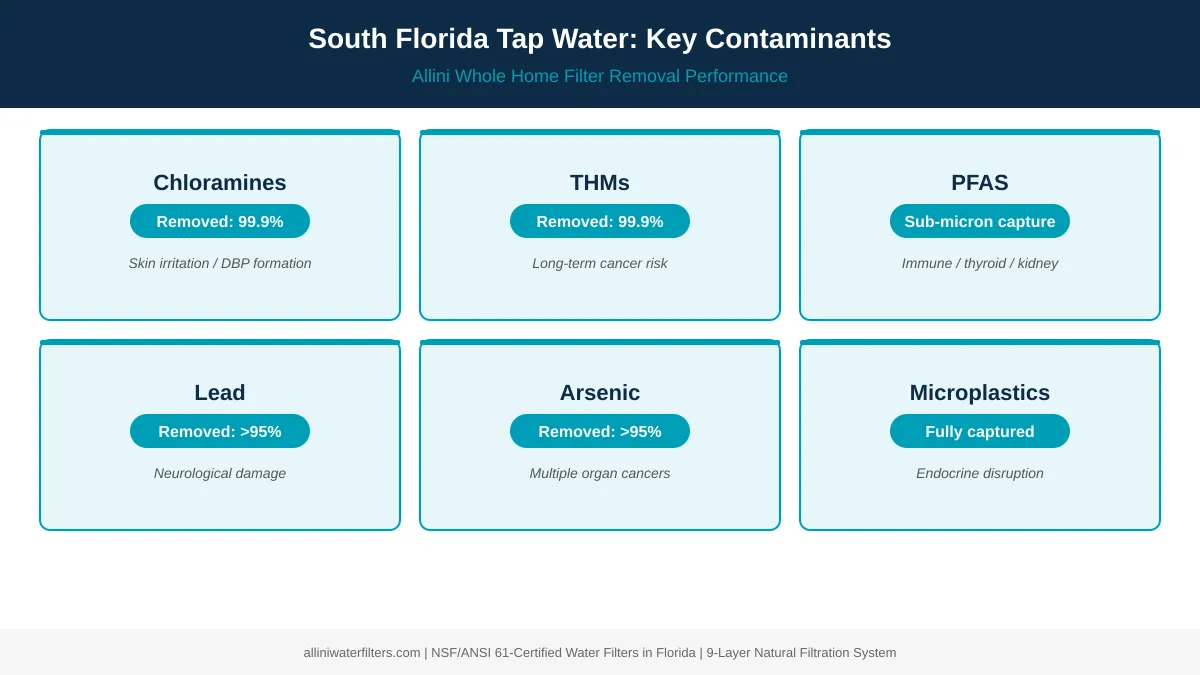
South Florida Tap Water Contaminants at a Glance
| Contaminant | EPA Limit | FL Detection Status | Primary Health Concern | Allini Removes? |
| Chloramines | No limit (disinfectant) | Used by most S. FL utilities | Dry skin, irritation, DBP formation | Yes – 99.9% |
| Trihalomethanes (THMs) | 80 ppb | 50-75 ppb detected (Miami-Dade) | Bladder cancer risk (chronic) | Yes – 99.9% |
| PFAS (6 compounds) | 4 ppt (EPA 2024) | Detected near military sites + groundwater | Immune, thyroid, kidney, cancer | Yes – 99.9% (Carbon + Submicron Media) |
| Lead | Action level: 15 ppb | Risk from aging pipes (pre-1986 homes) | Neurological damage; no safe level for children | Yes – >95% (KDF + sub-micron) |
| Microplastics | No federal limit | Confirmed in FL tap water studies | Endocrine disruption (under study) | Yes – sub-micron filtration |
| Arsenic | 10 ppb | Trace levels in some FL groundwater | Liver, lung, bladder, kidney cancer | Yes – >95% (sub-micron) |
| Chlorine (residual) | 4 ppm (MRDL) | Present at point of use | Taste, odor, THM precursor | Yes – 99.9% |
Sources: US EPA, Florida DEP Annual Water Quality Reports, Allini 3rd-party lab testing (Jupiter, FL post-installation results).
The Most Common Contaminants in South Florida Tap Water
South Florida’s municipal water comes primarily from the Biscayne Aquifer in Miami-Dade, Broward, and Palm Beach Counties. This shallow limestone aquifer is highly productive but also highly vulnerable to surface contamination from agricultural runoff, urban stormwater, and industrial discharge. Each county’s water authority treats this source water, but treatment introduces its own byproducts.
Chloramines
Most South Florida utilities switched from chlorine to chloramines as their primary disinfectant in the 1990s. Chloramines are more stable in distribution pipes as they do not dissipate before reaching your tap but they are also harder to remove. Standard activated carbon filters, including most pitcher and faucet filters, are ineffective against chloramines. Chloramines in shower and bath water absorb through skin and lungs and are associated with dry skin, respiratory irritation, and the formation of toxic disinfection byproducts in the distribution system.
Trihalomethanes (THMs) and Halo Acetic Acids (HAAs)
These are the byproducts formed when chlorine or chloramine react with organic matter in the water. Miami-Dade’s annual reports have shown THM levels between 50 and 75 ppb inside the 80 ppb legal limit but well within the exposure range that population studies have linked to elevated bladder cancer risk with decades of consumption.
PFAS – The Forever Chemicals
PFAS compounds were detected in Florida’s drinking water near military installations including Tyndall Air Force Base, Eglin Air Force Base, and Patrick Space Force Base. The EPA’s 2024 maximum contaminant level of 4 parts per trillion reflects how seriously regulators now view even trace exposure. Multi-stage whole home filtration with sub-micron media is one of the most effective residential approaches available for PFAS reduction.
Heavy Metals – Lead, Arsenic, and Mercury
Lead in Florida tap water rarely comes from the source. It comes from aging service lines and plumbing fixtures inside homes. Pre-1986 homes in South Florida may contain lead solder in their pipes. The CDC has stated that no level of lead exposure is safe for children. Arsenic is found at trace levels in Florida groundwater, particularly in areas with phosphate mining history.
Microplastics
Florida tap water was among the samples tested in multiple independent studies between 2019 and 2024 showing widespread microplastic presence in US municipal water supplies. There is currently no EPA maximum contaminant level for microplastics. Research into chronic low dose microplastic exposure is ongoing, with early studies pointing to potential endocrine disruption and inflammatory responses.
South Florida Tap Water by County
Not all Florida tap’s water carries the same contaminant profile. The source, treatment method, and distribution infrastructure vary meaningfully across the major counties Allini Water Filters serves.
| County | Primary Water Source | Key Contaminants of Concern | Water Hardness | Notable Issues |
| Miami-Dade | Biscayne Aquifer + treatment plants | THMs, chloramines, trace PFAS, arsenic | Very hard (250+ mg/L) | High industrial and agricultural runoff history |
| Broward | Surficial Aquifer + regional treatment | Chloramines, THMs, tannins, sediment | Hard (180-230 mg/L) | Agricultural drainage into water supply |
| Palm Beach | Well fields + Lake Okeechobee watershed | THMs, chloramines, seasonal algal toxins | Hard-very hard (200-280 mg/L) | Algae bloom events affect source water quality |
| Sarasota | Peace River watershed | Chloramines, THMs, trace PFAS, tannins | Moderately hard (100-180 mg/L) | Aging infrastructure in older neighborhoods |
| Collier / Naples | Tamiami Aquifer + brackish water treatment | Chloramines, sediment, trace salinity | Hard-very hard (240+ mg/L) | Brackish water treatment adds complexity |
Source: Florida Department of Environmental Protection, County Utility Consumer Confidence Reports, 2024-2026.
What a Whole Home Water Filter System Actually Does
A whole home water filter, also called a point-of-entry (POE) filter, treats every gallon of water as it enters your home at the main supply line. That means the water from your kitchen tap, bathroom showers, laundry machine, dishwasher, and garden hose all pass through filtration before reaching any fixture.
This is fundamentally different from a point-of-use (POU) filter like a pitcher or under sink unit, which treats only the water at one specific tap and leaves every other water source in the home completely unfiltered.
Point of Entry vs. Point of Use – Side-by-Side Comparison
| Feature | Whole Home Filter (Point of Entry) | Under-Sink / Pitcher (Point of Use) |
| Coverage | Every tap, shower, appliance in the home | Single kitchen tap only |
| Shower water protection | Yes – chloramines removed before shower | No |
| Appliance protection | Yes – scale, rust, chloramines removed | No |
| Laundry water | Yes – cleaner wash, protects fabric | No |
| Maintenance required | None (Allini: 1 million gallons / 7 years) | Cartridge every 3-6 months; membrane annually (RO) |
| Contaminants removed | Full spectrum: chloramines, PFAS, heavy metals, microplastics, bacteria, THMs, sediment | Limited – varies by filter type; pitcher filters do not remove chloramines or PFAS |
| 5-year cost | One-time installation; no ongoing cartridge cost | $150-$400/year in cartridge replacements |
The Allini Whole Home Water Filters for Florida, the Series 900, 1200, and 1600 treat water at the main supply line using a multi stage natural media system. Nine media layers work in sequence, each targeting a different class of contaminants, together removing 99.9% of the 15 plus contaminant categories most relevant to South Florida water quality.
Learn more: Allini Whole Home Water Filters – Series 900, 1200 & 1600
How Allini’s Multi Layer System Targets South Florida’s Specific Contaminants
Allini Water Filters for Florida do not ship a generic filter and call it done. Each system is configured to match the water chemistry of the specific Florida municipality where it is installed. That customization begins with a free water test before installation.
Catalytic Activated Carbon
This is the critical layer for South Florida homes. Most whole home filter manufacturers use standard granular activated carbon, which handles chlorine well but is largely ineffective against chloramines. Allini uses catalytic activated carbon certified to NSF/ANSI Standards 42 and 61. Its catalytic surface promotes the reduction reaction that breaks down chloramines, the dominant disinfectant in South Florida’s water supply along with THMs, VOCs, and hydrogen sulfide.
KDF 55 Process Media
KDF 55 is a high purity copper-zinc formulation that removes heavy metals through a redox (oxidation reduction) reaction. Lead, mercury, arsenic, and iron are converted into harmless forms and trapped in the media. KDF also creates an environment hostile to bacteria and algae growth inside the filter system. It is certified to NSF/ANSI Standard 42.
Sub-Micron Filtration Layer
The Allini sub-micron filter achieves 2 to 3 micron particle retention. Independent laboratory testing documents – lead reduction above 95%, arsenic reduction above 95%, bacteria and E. coli elimination above 99.99%, virus removal above 99.99%, and microplastic particle capture. This layer also captures PFAS, which standard whole-home filters do not address.
Bio-Ceramics and Water Balance Technology
Bio-ceramics naturally raise the water’s pH to between 7.5 and 9.0, creating mildly alkaline water. Allini’s proprietary Water Balance Technology conditions calcium and magnesium minerals so that they remain in the water in a non scale forming state. Beneficial minerals are preserved. Scale buildup on showerheads, appliances, and pipes is prevented without salt, without resin, and without chemicals.
Allini Filter Media – Contaminants Targeted and Removal Rates
| Allini Media Layer | Targeted Contaminants | NSF Certification | Verified Removal Rate |
| Catalytic Activated Carbon | Chloramines, THMs, VOCs, chlorine, hydrogen sulfide | NSF/ANSI 42 & 61 | 99.9% chloramines; >99% THMs |
| Granular Coconut Shell Carbon | Chlorine, organic compounds, taste, odor, ozone | NSF/ANSI 42 & 61 | 99.9% chlorine removal |
| KDF 55 Media | Lead, mercury, arsenic, iron, bacteria control | NSF/ANSI 42 | >95% lead; >95% arsenic |
| Sub-Micron Filter | Microplastics, bacteria, viruses, cysts, heavy metals, PFAS | NSF/ANSI 61 | >99.99% bacteria/viruses; >95% lead; >95% arsenic |
| Garnet + Rapid Sand | Sediment, silt, rust, fine particles | ANSI/NSF 61; AWWA B100 | 3-5 micron particle retention |
| Bio-Ceramics | pH correction, mineral structuring, antioxidant ORP | Independent 3rd-party tested | pH raised to 7.5-9.0; improved hydration |
Data sourced from Allini NSF Component Certifications, Allini Matrix documentation, and independent 3rd party testing. Full reports available at alliniwaterfilters.com.
What Florida Homeowners Actually Notice After Installation
The results of Allini customers in Miami, Fort Lauderdale, Boca Raton, West Palm Beach, and across South Florida report after installation fall into consistent categories that go well beyond taste.
Taste and odor
Chlorine and chloramine taste and smell disappear within days. Customers consistently describe the water as clean and neutral.
Skin and hair
Dryness, irritation, and scalp sensitivity reduce notably and is consistent with the removal of chloramines from shower water, which the body absorbs dermally and through inhalation.
Scale disappears
Water Balance Technology conditions calcium and magnesium, so they no longer form white deposits on showerheads, faucets, and appliance heating elements.
Appliance protection
Without chloramines and scale, water heaters, dishwashers, and washing machines run cleaner and last longer.
As Catherine Anderson, a Certified Health Coach in Palm Beach, shared after her Allini installation – “I researched all the types of filtrations including RO and this surpasses them all with less waste. I am now recommending Allini Water to all my neighbors in Boynton Beach.”
Read More from This Series
This article is part of Allini’s whole home water filter content series for Florida homeowners.
Allini Water Filters – Florida’s Premium Water Filtration Brand
Allini Whole Home Water Filters – Series 900, 1200 & 1600
A blog on – Hard Water in Florida: The Hidden Damage to Your Home and How a Whole Home Filter Solves It
A Blog On – Why Zero-Maintenance Water Filters Last Longer and Cost Less Over 7 Years
A Blog On – Whole Home Water Filter vs. Reverse Osmosis: Which Is Actually Better for a Florida Home?
Frequently Asked Questions
Q1. Does South Florida tap water meet EPA standards?
Ans – Yes. All major South Florida utilities comply with federal EPA and Florida DEP drinking water standards. Compliance means the water is within legal limits, not that it is free of all health relevant contaminants. Many contaminants including microplastics, have no current federal limit and are not reported in annual water quality reports even when detected.
Q2. Can a whole home water filter remove chloramines from South Florida water?
Ans. Yes, but the filter type matters. Standard activated carbon handles chlorine well but is largely ineffective against chloramines, which require catalytic activated carbon for proper removal. Most South Florida utilities use chloramine based disinfection. Allini whole home water filters use catalytic carbon certified to NSF/ANSI Standard 42, the correct technology for chloramine removal at South Florida’s typical concentrations.
Q3. Is PFAS in Florida drinking water a real concern for homeowners?
Yes. PFAS compounds have been detected near military installations and in broader Florida groundwater from agricultural and industrial sources. The EPA established enforceable limits for six PFAS compounds in 2024 at 4 parts per trillion. Multi stage whole home filtration with sub-micron media is one of the most effective residential approaches available for PFAS reduction.
Q4. What is the difference between a whole home water filter and a water softener for Florida homes?
Ans. A water softener removes calcium and magnesium hardness minerals through ion exchange, replacing them with sodium but it does not remove chloramines, PFAS, heavy metals, or microplastics. Allini’s Water Balance Technology conditions hardness minerals so they remain in the water without forming scale, providing the functional benefits of softening without salt, sodium, or chemical treatment.
Q5. Does boiling South Florida tap water remove contaminants like PFAS or chloramines?
Ans. Boiling is effective against biological contaminants such as bacteria and viruses, but it does not remove chemical contaminants. Chloramines, THMs, PFAS, lead, and microplastics are unaffected by heat. Boiling concentrates dissolved chemicals as water evaporates, leaving the remaining water with a higher concentration of non volatile contaminants than before boiling. For South Florida tap water, where the primary concerns are disinfection byproducts, PFAS, and heavy metals, boiling alone is not a meaningful treatment strategy.
Q6. Are microplastics regulated in Florida drinking water?
Ans. No. As of 2026, the EPA has not established a maximum contaminant level for microplastics in drinking water. They are not regulated and are therefore not required to be reported in annual water quality reports even when detected. Allini’s sub-micron filtration layer with pore sizes down to 2 to 3 microns is specifically designed to capture microplastic particles before they reach any tap in your Florida home.
The Bottom Line for Florida Homeowners
South Florida tap water is legal, but legal and healthy are not interchangeable, particularly when the limits governing your water were written before researchers fully understood lifetime low dose exposure to chloramines, THMs, and PFAS. A whole home water filter system is the only approach that addresses the full scope of what is flowing through your pipes, from the point where water enters your home to every shower, faucet, and appliance it reaches.
For Florida homeowners who want water that is genuinely clean and not just compliant, Allini Water Filters for Florida provides a zero maintenance system engineered specifically for South Florida’s water chemistry with a free water test to confirm the right configuration for your home.
 Facebook
 Twitter
 Pinterest